- MISSION+
- Posts
- March 2026 — Friction, Fiction, and Prediction
March 2026 — Friction, Fiction, and Prediction

MISSION+
March 06, 2026

When someone wants to remember an open source project that is hosted on GitHub (the main open source code hosting provider), they can click a small yellow star to add it to their list of projects. The number of stars is often used as a proxy for how popular a project is.
OpenClaw is an AI personal assistant that took the world by storm. Its takeoff of GitHub stars is perpendicular.
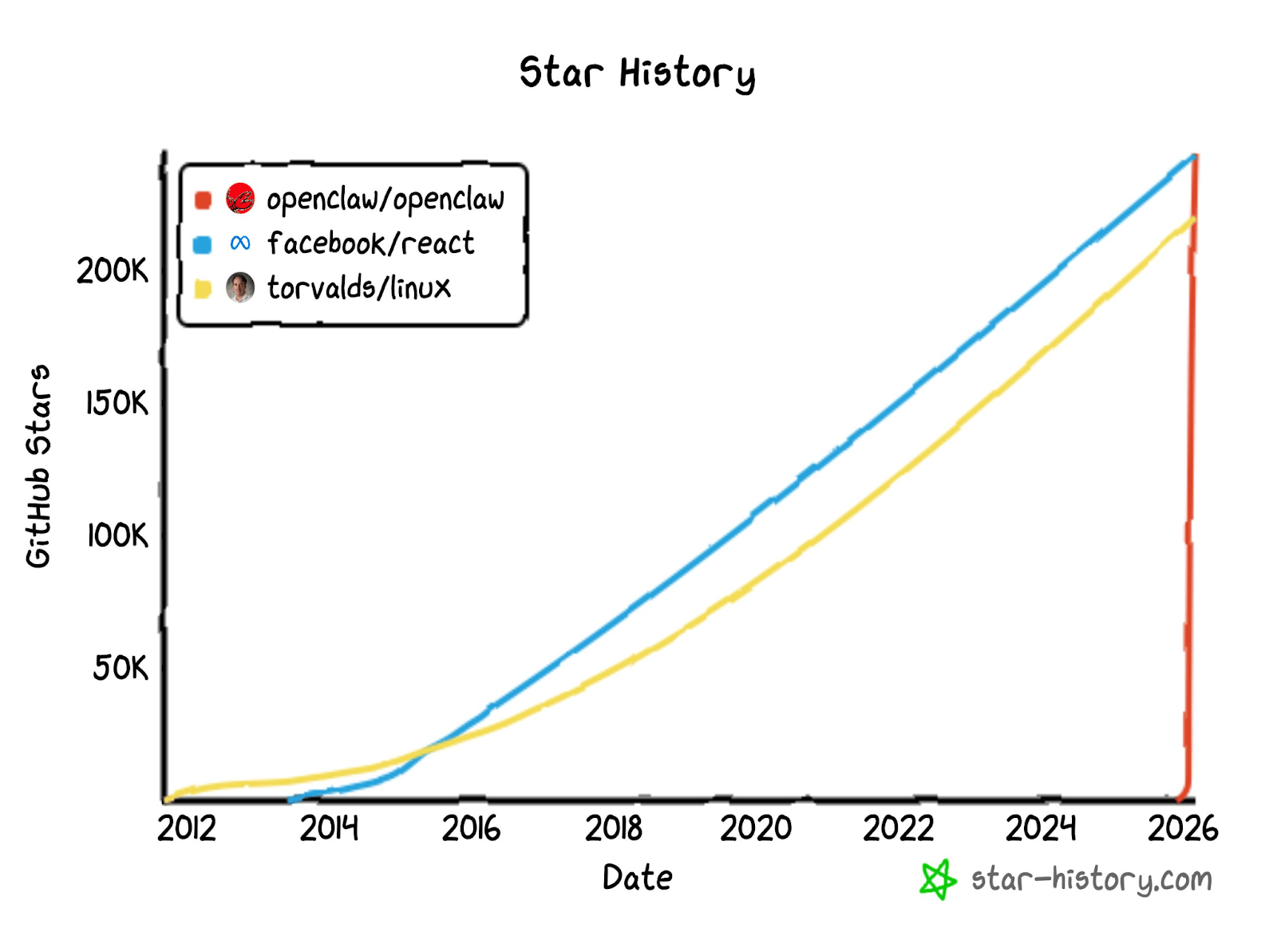
Why? For many people, this was the first glimpse into an autonomous assistant that could help them day to day. But again, why OpenClaw and not any of the attempts that came before?
To me, the answer lies in the complaints about OpenClaw security that soon emerged. “What? You gave it complete access to your email?”. “What? It can us` your stored browser credit cards without constraint?”
But these questions got it wrong. From the perspective of the user, this was not a security vulnerability - it was a feature.
Users liked that it had access to everything, that was what provided them value. To “correctly” lock it down would remove much of the reason they were using it in the first place.
I don’t have the answer, but I recognise that saying “agents can’t have access to potentially sensitive parts of my life” is about as useful as preaching abstinence to teenagers. An approach that acknowledges the benefits, but encourages protection is the more pragmatic option.
This overlaps with our transition to a post-privacy society. As Peter Diamandis has frequently said, “Privacy is Dead”. Most of us accept that Google reads our emails, tracks our searches and follows our location on Maps - because, like OpenClaw, we trade risk for convenience.
The questions about personal data security and privacy were always present, but the emergence of workable agents has thrust them to the top of the list. What do we choose to risk? What loss of privacy do we take as given?
And perhaps most importantly: how do we start baking guardrails into our operating systems and platforms? We cannot assume people will configure things correctly, or with a security-first mindset. The modern computing environment must protect us from ourselves. Not a small ask.
Small aside: OpenClaw was originally called Clawdbot, and was effectively a Claude advertisement. Anthropic legal went after them, so they changed the name. Then OpenAI bought them, and won all the reflected glory of one of the most successful open source stories of all time. Talk about missed opportunities.

Reflections On The Mission
My mobile phone is useless for calls. The sheer volume of sales and spam calls means I no longer pick up if I don’t recognise the number. Never mind scam and phishing calls.
I don’t know how my number got into RocketReach, ZoomInfo and the like - but once it did, it ruined my ability to pick up the phone to an unknown number.
But this causes problems. I miss important calls from my bank, and similar institutions trying to get hold of me.
That’s just phone calls. The issue exists with pretty much every interaction with the outside world. Aside from scams and spam, many of our processes rely on barriers to entry to not become unmanageable. Posting a job on LinkedIn already invites hundreds of “Easy Apply” submissions, but if you ask even the simplest question (“Tell me in two paragraphs why you want this job”), 90% don’t respond. With AI, most of them will.
It is becoming impossible to differentiate between something useful, slop and scams. AI removes the friction filter, and amplifies the noise. Something has to give.
I think that trust and reputation systems are going to start being embedded into many of our interactions.
This was done before with email domains - so we just need to do something similar, on a much larger scale. Reputation scores then tagged to individuals - using some kind of ID system like Worldcoin, or country-specific alternatives.
Of course trusting that trust infrastructure becomes its own problem - there have been multiple blockchain-based projects to try and tackle that, such as Affinidi.
Mitchell Hashimoto is one of the world’s most famous open source developers, and he has recently launched vouch - a platform for community trust management. His initial use case was to prevent people submitting useless AI-generated code changes to his projects. Unless someone has vouched for you, you can’t contribute.
Over time, I am sure that this trust infrastructure will extend to agents - both for the agent, and for the functionality and data sources that the agents visit. Trusted agents will be given freer access than those that are unvouched for. Sites that other humans and agents have rated accurate will be given precedence as the agent searches for information.
An exciting future, but I’ll be happy enough if we just fix things well enough that I can start using my phone again.
Interesting Articles
Something Big Is Happening — matt shumer - this went viral, and while some of it may be a little hyperbolic, the core message is absolutely true: Something Big is Happening.
From vibe coding to agentic engineering - the author Sau Sheong is CTO of Singapore’s GovTech, and is a highly respected leader in the field. Always worth listening to what he has to say!
World Monitor - vibe coded goodness for when you need to monitor the situation.
This Is The Way
Feature A Fractional

We’re On A Mission


Until next month. Together, We Build {+}
Ned & the MISSION+ team
P.S. If you would like to bring the MISSION+ team into your organisation to help, please reach out to [email protected]!